a
News
Passive Cooling Strategy in Steel-Based Bali Villas
Designing for Climate, Not Against It
Bali’s tropical climate presents consistent humidity, high solar exposure, and minimal seasonal variation. Traditional cooling solutions rely heavily on mechanical air conditioning systems, which increase operational costs and long-term energy dependency.
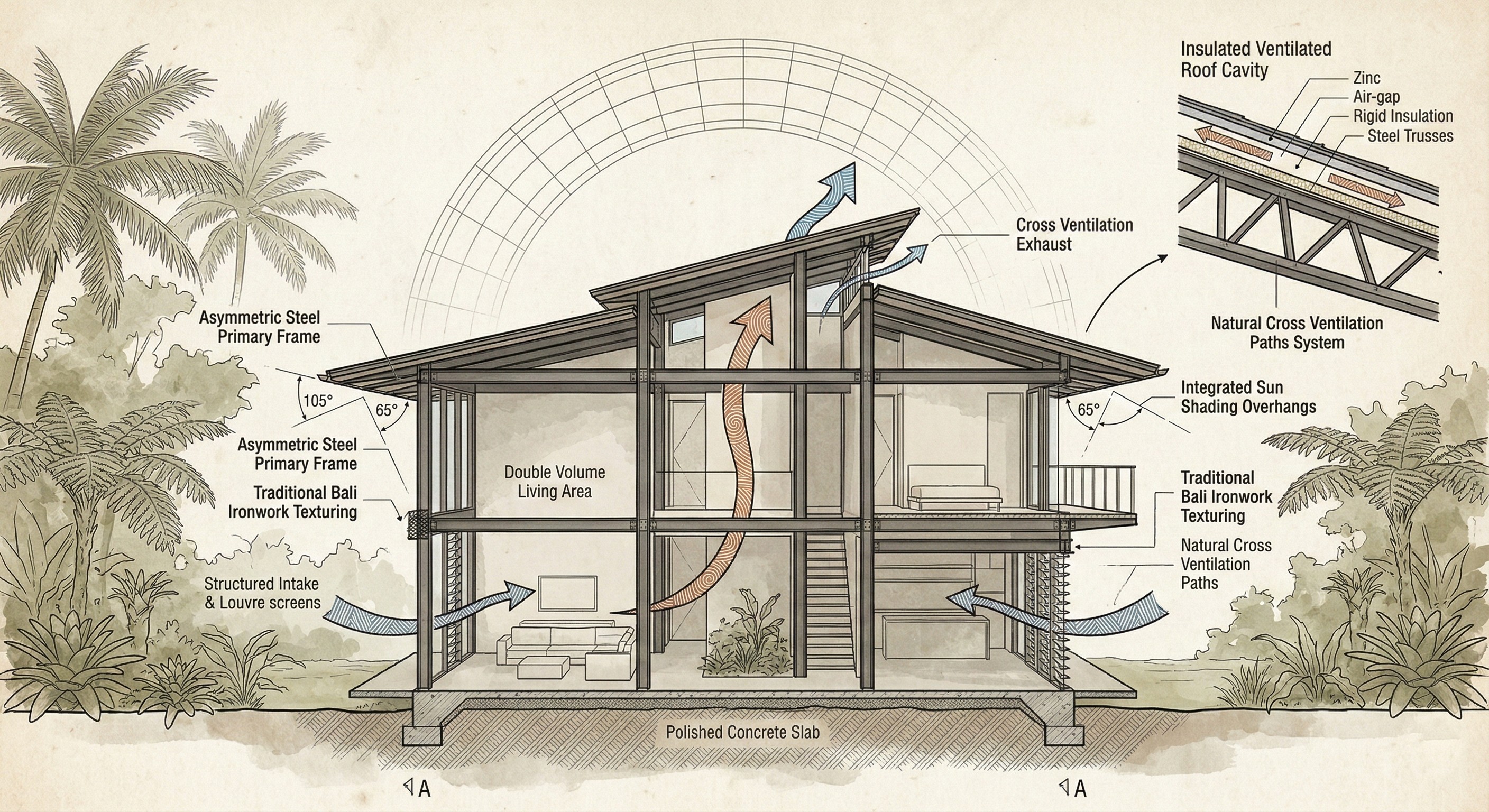
Modern villa construction integrates passive cooling strategies directly into structural and spatial planning. Steel-based systems allow wider spans, elevated roofs, and optimized cross-ventilation channels that improve thermal behavior naturally.
Instead of forcing indoor comfort through energy consumption, contemporary engineering reduces heat gain at the source — through orientation, airflow, shading geometry, and structural elevation.
When structure and climate logic align, comfort becomes architectural rather than mechanical.
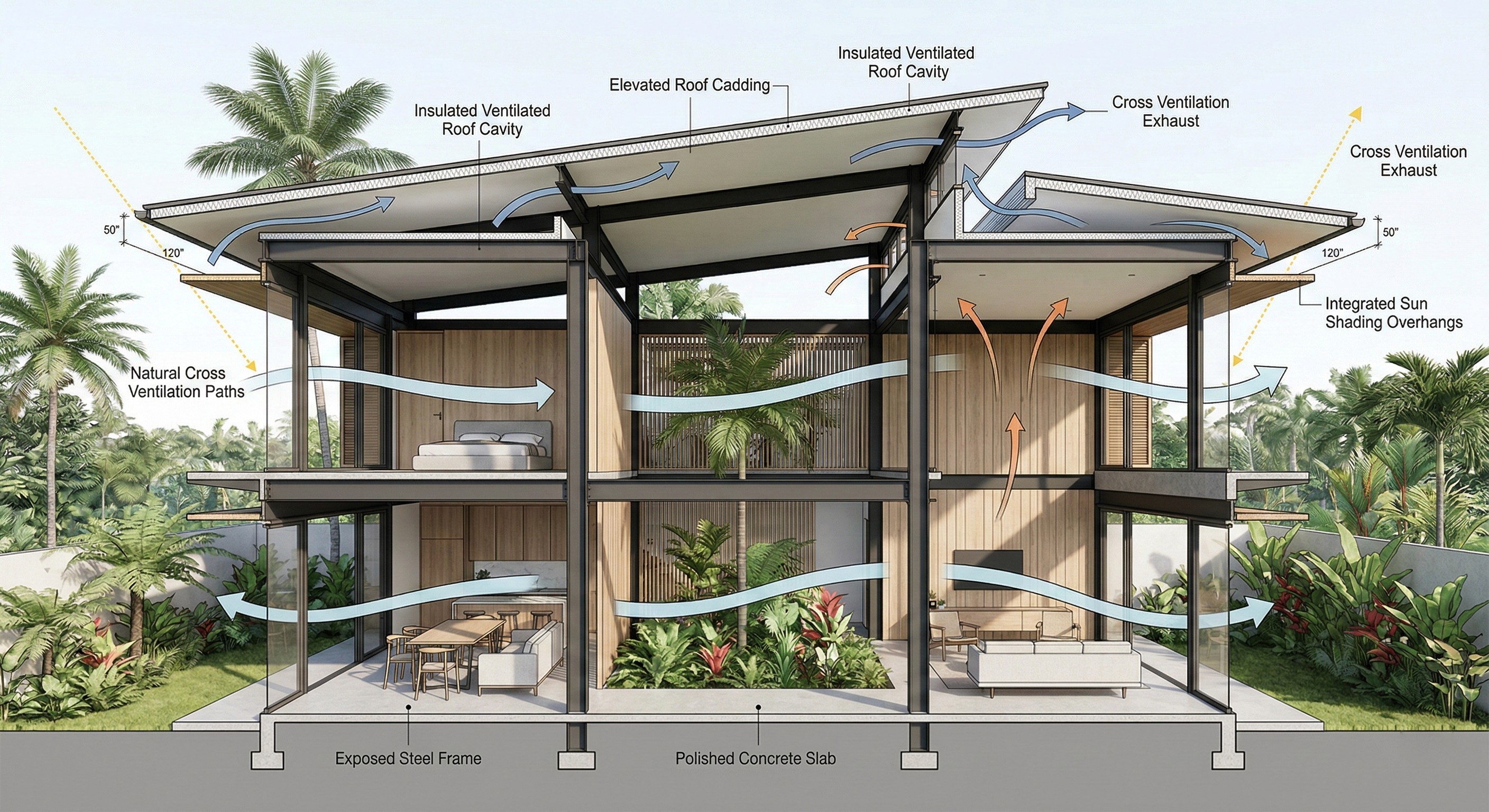
Airflow engineering begins at structural level.
“The most efficient cooling system is intelligent design.”
Key Points — Architectural Strategy Behind Passive Cooling
Passive cooling is not a single feature but a coordinated system of design decisions. In steel-based villa construction, structural flexibility allows precise spatial optimization that supports airflow efficiency.
Steel framing enables larger uninterrupted openings. This increases the effectiveness of cross ventilation, particularly when positioned in alignment with prevailing coastal winds common in Bali’s southern regions.
Elevated roof structures create thermal chimneys. As warm air rises, it escapes through controlled ventilation gaps beneath roof ridges, drawing cooler air inward through lower-level openings. This stack effect reduces indoor temperature fluctuations without mechanical support.
Extended roof overhangs and structural cantilevers limit direct solar radiation on glazing surfaces. By reducing heat gain before it enters the building envelope, cooling demand decreases significantly.
Additionally, raised floor systems — achievable through steel substructures — improve air circulation beneath the villa, preventing ground moisture heat transfer.
These integrated decisions produce measurable long-term benefits:
Lower energy consumption
Reduced air conditioning load
Improved indoor air quality
Greater comfort stability throughout the day
Increased long-term operational efficiency for investors
Passive cooling is not aesthetic — it is financial strategy embedded in engineering.
Technological Points — Engineering Systems Supporting Climate Performance
Advanced modeling tools and material technologies ensure passive design performs as calculated.
Digital solar path analysis allows engineers to position openings and shading structures according to seasonal sun angles specific to Bali’s latitude. This prevents overexposure during peak solar hours.
Computational airflow simulation predicts interior ventilation efficiency before construction begins. Engineers evaluate pressure differences, wind direction impact, and cross-ventilation success rates.
Thermal bridging mitigation within steel systems is addressed through insulated connectors and composite material layering. This ensures structural efficiency does not compromise thermal comfort.
High-performance roofing membranes combined with reflective insulation layers reduce radiant heat transfer through roof assemblies — a critical factor in tropical climates.
Moisture control systems integrated within wall assemblies prevent condensation buildup, preserving structural longevity in high-humidity environments.
Together, these technologies transform passive cooling from theory into quantifiable building performance.